USMLE Score Predictor for Step 1, Step 2 CK and Step 3
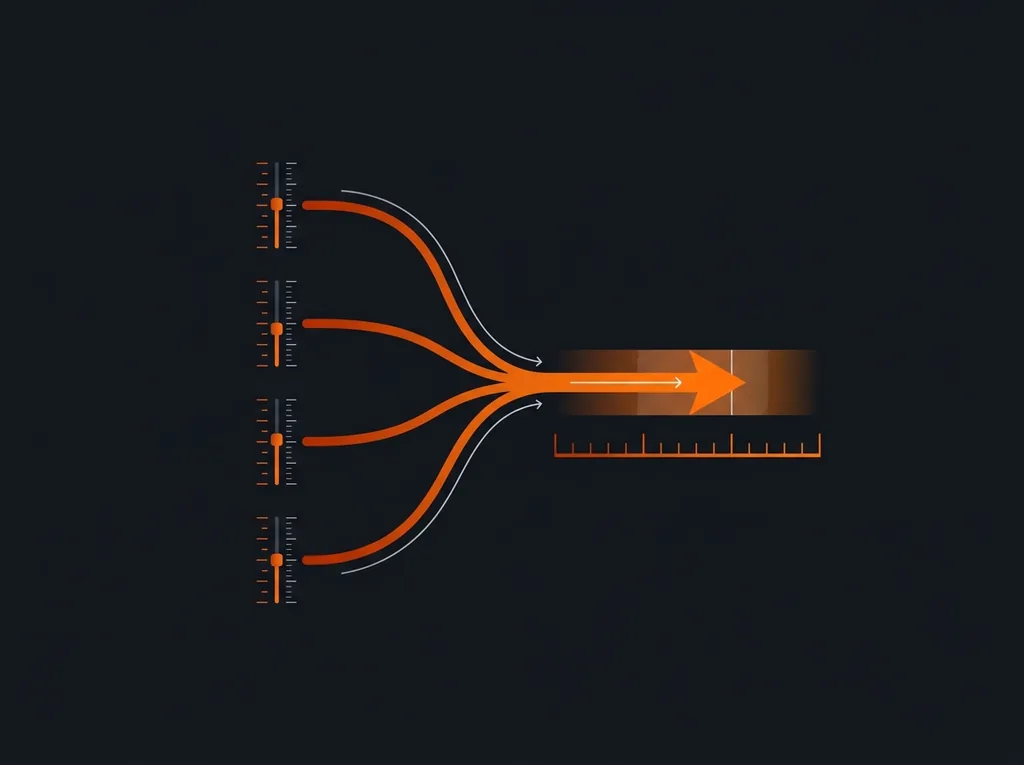
This free USMLE score predictor turns a pile of practice test scores into one number. Enter every NBME, UWorld self-assessment, Free 120, AMBOSS or CMS result with the date you sat it, and read back a recency-weighted estimate and the confidence range your inputs actually support.
Not affiliated with, endorsed by, or sponsored by the NBME® or USMLE®. Educational estimates only.
Marks your goal on the range bar and shows the gap to your estimate.
How each result was weighted
recent = heavier- UWorld SA 2242 · 5d ago · 50%
- NBME self-assessment240 · 14d ago · 31%
- UWorld SA 1220 · 28d ago · 20%
How the USMLE score predictor works
What the USMLE score predictor takes in
Each row of the USMLE score predictor is one assessment: the provider, the score it reported, and how many days ago you sat it.
Six providers feed the USMLE score predictor: NBME self-assessments, UWorld SA 1 and SA 2, the Free 120, AMBOSS self-assessments and CMS forms.
Percent-scored forms are mapped onto the three-digit scale first, so 78% on the Step 1 Free 120 enters the USMLE score predictor at roughly 206, and 75% on the Step 2 CK Free 120 at roughly 232.
Results that already report three digits reach the USMLE score predictor exactly as typed. Nothing is rounded away, rescaled, or quietly dropped.
What the USMLE score predictor gives back
Four things. A point estimate, a ± interval, the pass probability for that exam’s standard, and each row’s share of the USMLE score predictor blend.
That share column is where the USMLE score predictor shows its working. One recent form often carries half the weighted prediction on its own.
Read the interval before the headline number. A USMLE score predictor that hands you a single figure with no width has hidden the part that decides whether to sit the exam.
How the USMLE score predictor weights recency
This is a weighted mean, not a flat average. The USMLE score predictor scales every result by 1 ÷ (1 + days ÷ 10) before blending it.
Sat today, a form carries a weight of 1.00 in the USMLE score predictor. Ten days back it carries 0.50, a month back 0.25, two months back 0.14.
The difference is not cosmetic. An NBME of 218 sat thirty days ago beside a UWorld SA 2 of 236 sat five days ago averages 227, but the USMLE score predictor returns 231.
Swap the dates and those same two numbers come back 223, because the USMLE score predictor is reading your score trend rather than your arithmetic mean.
Nothing is ever deleted. Old sittings keep a voice in the USMLE score predictor; recency weighting just stops them dominating a run of newer work.
What the USMLE score predictor says per exam
The USMLE score predictor on Step 1: the margin
Step 1 has been reported pass or fail since January 2022, so a USMLE score predictor number is not something you can put on an application.
What it is good for is distance from 196, the Step 1 passing standard, which this USMLE score predictor turns into a pass probability.
That curve moves fast near the line. In the USMLE score predictor a single NBME at 196 returns exactly 50%; 200 returns 69.9%, 205 returns 88.0%, 210 returns 96.6%.
Fourteen points separate those four readings, and the USMLE score predictor still prints a ±15 confidence range beside every one of them.
More inputs tighten it. Three Step 1 forms — 208 forty days ago, 214 twenty days ago, a UWorld SA 1 of 219 three days back — leave the USMLE score predictor at 216, ±12, so 204 to 228.
Step 2 CK: where the USMLE score predictor counts
Step 2 CK still reports a three-digit score, so the USMLE score predictor point estimate matters as much as the margin. The passing standard here is 218.
A single NBME entered at 218 leaves the USMLE score predictor at exactly 50%, which is what sitting on the standard actually means.
One assessment at 225 takes the USMLE score predictor to 82% and a range of 210 to 240: clear of the line on the estimate, still touching it at the bottom.
That overlap is the argument for sitting another form rather than booking the date.
Step 3 score prediction from the same inputs
Step 3 runs through the USMLE score predictor against a 200 standard, in force since 1 January 2024, with identical weighting and interval arithmetic.
It is the target most people hold the fewest inputs for, so the USMLE score predictor usually rests on one or two rows here and stays near the ±15 floor.
How accurate the USMLE score predictor is
The interval is the USMLE score predictor claim
An offline USMLE score predictor cannot audit itself against real exam outcomes, so the width of the interval is the accuracy claim.
One assessment produces a ±15 point range, and that is the USMLE score predictor floor. No amount of confidence in a single sitting narrows it.
Agreement is what the USMLE score predictor rewards. Two results at the same score on the same day return ±11; three return ±9.
Disagreement is what it punishes. Two scores ten points apart return ±14, and a 205 beside a 255 returns ±50 from the USMLE score predictor.
So when your results split by more than ten points, the useful question is why, not what the average of them is.
You will not find a validation statistic here. Other sites quote correlations from cohorts of their own; those are their figures, and this USMLE score predictor does not borrow evidence it has not collected.
What the USMLE score predictor cannot see
The conversions under this USMLE score predictor come from publicly circulated data built on community-reported results, not from the exam makers.
NBME publishes no formula turning a self-assessment into a three-digit score, so every offline USMLE score predictor, this one included, is a reconstruction rather than an official reading.
The USMLE score predictor also knows nothing about your exam day. Content sampling varies between forms, fatigue lands at hour six, and a bad night before the test shows up in none of the numbers you typed.
It cannot tell whether you sat a form timed or with the clock paused, or whether a high score means mastery or a form you had already seen.
Use the USMLE score predictor for direction and readiness rather than for one high-stakes decision. Two forecasts six weeks apart say more than either one alone.
When a USMLE score predictor is the wrong tool
Holding one result only? A converter answers that better than any USMLE score predictor can — start from a single form instead.
Or go straight to Step 1 forms 25 to 31 and Step 2 CK forms 9 to 15, then bring the numbers back here.
Once the forecast is one you believe, turn the prediction into a schedule, or read the weighting rules in full.
Frequently asked questions
What this forecast is built from, and where it stops being useful.
How does the USMLE score predictor combine several NBMEs?
Enter each result with the date you sat it. The USMLE score predictor maps percent-scored forms onto the three-digit scale, weights each row by 1 ÷ (1 + days ÷ 10), and returns the weighted mean rather than a flat average.
How much more does a recent assessment count for?
Twice as much as one sat ten days earlier, four times as much as one from a month back. A six-week-old score describes a student who no longer exists, so the USMLE score predictor keeps it in the blend but quietly turns it down.
What if my results disagree by more than ten points?
Check the conditions before the scores: timed or untimed, one sitting or three. If nothing differed, the honest reading is a wide band — 205 beside 255 returns ±50, which is the USMLE score predictor saying it cannot reconcile them.
How accurate is the USMLE score predictor?
No offline USMLE score predictor can audit itself against real exam outcomes, and this one does not pretend to. One assessment yields ±15 points, three consistent ones about ±9. Read that width as the accuracy claim — it is the only one your inputs support.
Does the USMLE score predictor cover Step 3?
Yes. Step 3 is one of the three USMLE score predictor targets, scored against a 200 standard, with the same weighting and interval arithmetic. Most people hold fewer Step 3 self-assessments, so those forecasts sit near the ±15 floor.
Is this a free USMLE score predictor?
Free, and nothing is held back. There is no sign-up, no email step and no paid tier gating the interval, so the USMLE score predictor computes every number the moment you type a score.
When should I use a single-form calculator instead?
Use a form converter the day you finish a form, when the question is what that one assessment says. Use this page once you hold two or more results and want to know what they say together.
Does the USMLE score predictor store what I enter?
Nothing leaves your browser. The whole USMLE score predictor runs locally: mapping, weighting, interval, pass curve. Nothing is written to an account, and closing the tab discards every row.
Where to go next
Every tool here is free, needs no account, and runs entirely in your browser.
The USMLE score predictor above is free, needs no account, and gives you the interval as well as the number.
Not affiliated with, endorsed by, or sponsored by the NBME® or USMLE®. Educational estimates only.